L3 Lab CUA Week

During L3 Lab CUA week, we'll have several research releases about realtime agents that interact with the digital and physical worlds. Follow along if you're interested in realtime agents, multi-agent communication, RL environments, computer-use, robotics, or challenging new settings for frontier models.
-
Gym-Anything-RT: Scaling Real-Time Environments for Vision-Language Agents
Abstract
AI agents have made substantial progress in domains where they have a non-trivial amount of time to deliberate between actions, such as mathematics, software engineering, and performing tasks on desktop applications. It is less clear how such models fare in settings that demand real-time interaction, such as playing a video game or operating a physical device. In these settings, the environment state may evolve as the agent is reasoning, or even as the underlying model is performing a forward pass. To gain insight into the real-time interaction capabilities of vision-language agents, we introduce Gym-Anything-RT. Our key idea is to construct visual minigames that demand a portfolio of capabilities required for interactive real-time settings. Gym-Anything-RT uses an agentic pipeline to automatically generate such environments based on a taxonomy of six capabilities required for real-time interaction, including the ability to perceive the environment and act under an evolving environment state. A key feature of Gym-Anything-RT is that it allows for controlled comparison of real-time interaction capabilities: we can run the same minigame in real time, or pause or slow down the environment to relax the requirement for real-time actions. We use Gym-Anything-RT to construct 100 real-time minigames and evaluate AI agents on them. We find large capability gaps in real-time interaction. For example, GPT-6 Astra (xHigh) achieves a pass rate of only 9.0% on the real-time minigames, which rises to 75.0% when the environment is paused. We also identify intriguing behaviors by the most powerful frontier agents: for instance, when given the ability to write code, these agents write code that bypasses the need to perceive and act in real time. We publicly release Gym-Anything-RT and the generated minigames to spur further research on AI agents in real-time interactive settings.
-
SwarmChat: Open-Source Slack for Your AI Agent Swarm
-
Gym-Anything for Robotics: Scaling Physical Simulations with Digital Agents
Abstract
Realistic, fast robotics simulations could enable large-scale training of embodied AI models that transfer to the real world. However, despite decades of progress, available simulations cover only a narrow range of real-world tasks and physical phenomena. The core bottleneck is that creating better simulations requires significant expert effort and therefore does not scale. To address this, we introduce Gym-Anything for Robotics, a framework in which coding agents create realistic robotics simulations. Our core insight is that simulation creation is a coding agent task, so improvements in coding agents translate directly into richer and more faithful simulations. We select simulations based on U.S. GDP data to cover economically valuable physical work, define what makes a good simulation and a good task, and develop an adversarial creation-audit loop that checks each simulation and task against these definitions. Using this pipeline, we build RoboWorld, a set of 25 simulations with 25 test and 175 training RL environments of varying difficulty. Even the best frontier models fail on every RoboWorld test task, achieving an average reward of only 0.06. Building on RoboWorld, we introduce several new ways for frontier models to improve, including in-context learning across repeated attempts, a privileged teacher that reads the simulator state and teaches a student in context, self-assisted learning from the model's own privileged experience, and code policies that generate demonstrations across varied scenes to train vision-language-action models (VLAs) such as π0.5. Each of these substantially improves performance. We release our pipeline, RL environments, and benchmark to facilitate future research. Code and data are available at https://gym-anything.github.io/robotics
-
Visual Token Routing: Learning to Keep Tokens That Matter
-
Computer-Use Agents Are Embodied Generalists
Abstract
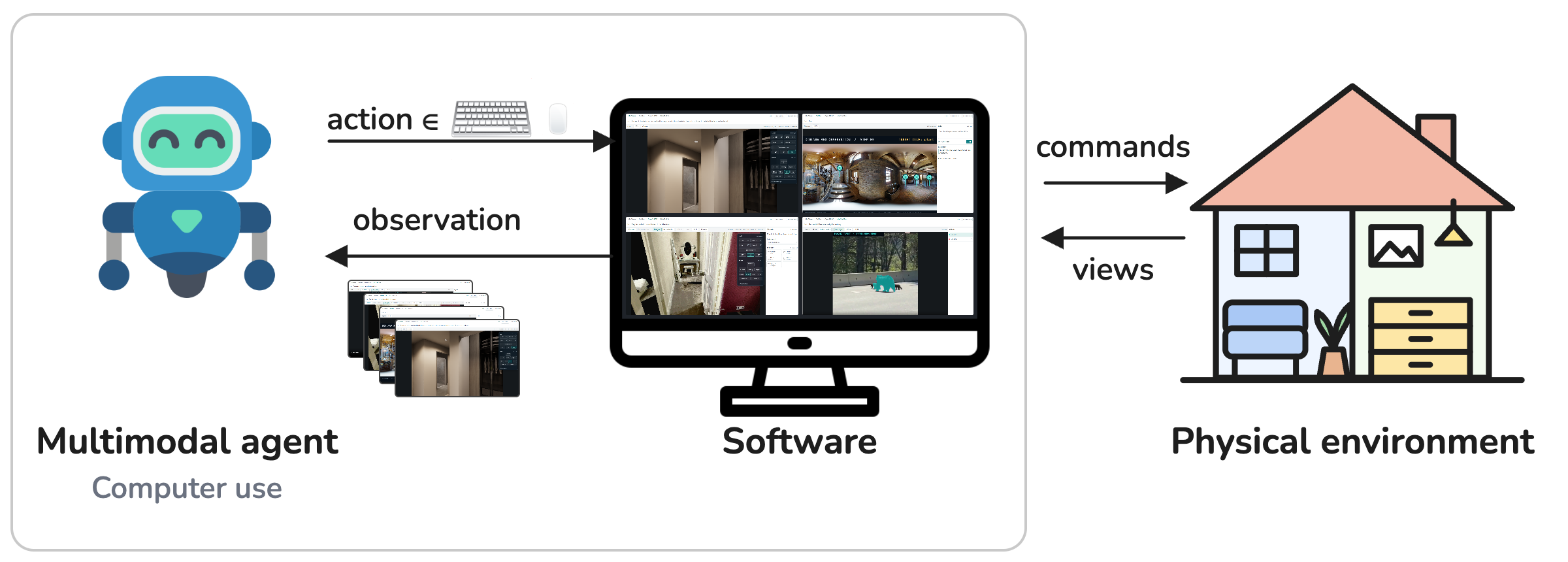
In many areas of AI, general-purpose models have increasingly replaced handcrafted methods and specialized architectures. We argue that embodied AI is poised for a similar shift. Our key claim is that embodied tasks can be formulated as interaction with digital software. Specifically, we build software that renders an agent's view of a physical environment on a screen and provides controls for acting in it. A computer-use agent (CUA) can then perform embodied tasks through the same screenshots and keyboard and mouse actions that it uses to operate ordinary software. Using a single CUA design and changing only the software, our entries win first-, second-, third-, and sixth-place prizes across four ECCV workshop competitions, without any competition-specific agent tuning. These results suggest that the skills CUAs learn on software, such as visual grounding, precise clicking, and exploration, already carry over to embodied tasks, giving CUAs a far broader scope in embodied AI than previously realized. We therefore advocate that computer-use agents can be embodied generalists. Further, we advocate that, by following the training strategy that made computer-use agents general, embodied AI can converge on a single general model as well, ushering in a new era of general embodied AI.
Pranjal Aggarwal, Sean Welleck · Paper
...